RED DEVIL LYE REVISITED
After talking to Dane (Helvetica), she renewed my interest in using lye (German Bath). Lye was something that I had tried long, long ago, before I knew much about cleaning, what a good coin looks like, patina etc.
So, here's another trial. I'm running two experiments simultaneously. Both groups were put into a plastic container, and 18 tablespoons of distilled water was added.
Group One, I added 4 tablespoons (level) of lye. This gives a 4.5 to 1 ratio. Group Two I added 3 tablespoons of lye, giving a 6 to 1 ratio (what Dane recommended).
I shook the container around a couple times while waiting. The first duration was for 5 minutes.
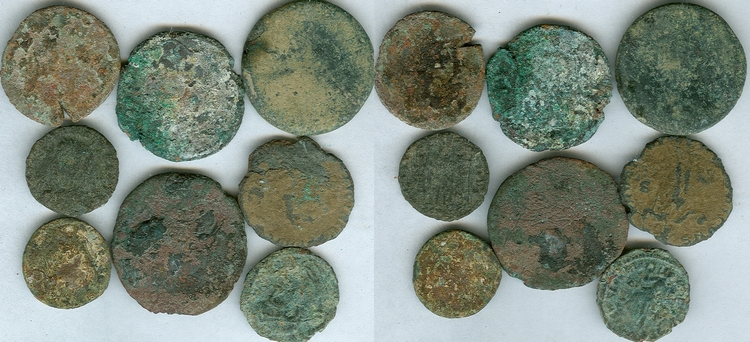
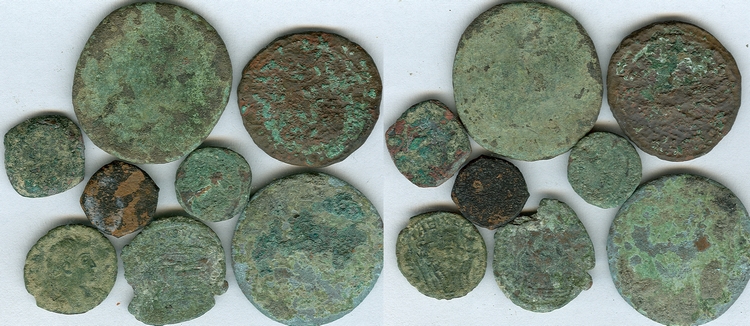
All of these coins are problematic in one way or another, and I tried to get a good assortment of factors/conditions in each group.
I have encrustation, good patina, false patina, flaky patina, dirt and everything in between demonstrated for each group.
Group one started as 35.9 grams, while group two was 33.3 grams. All coins were in a container with distilled water and sodium carbonate, so I shouldn't have any weight gain due to water being absorbed.
I removed the coins from the container with a pair of needlenose pliers; probably not the best tool to use, but I both wanted to reuse the mixture for round two, and I didn't want to risk touching the coins.
One must use precautions using this chemical; it is poisonous if you swallow it, and can easily burn your skin.
Each container turned a bluish black (the water) and dirt particles were in the bottom. I dropped the coins immediately into a bath of distilled water, then took them inside and rinsed them with hot water.
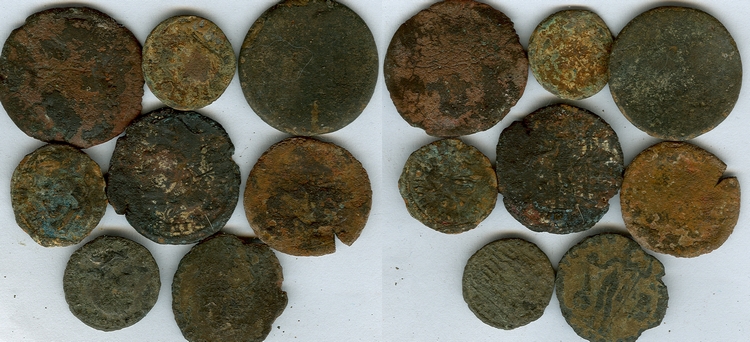
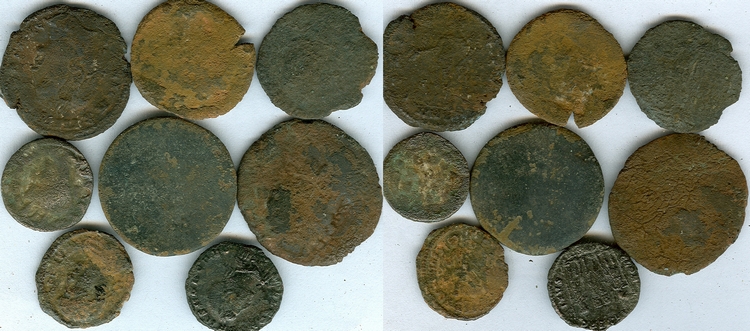
The coins as they were:
GROUP ONE
GROUP TWO
After a 5 minute soak:
GROUP ONE: 35.6 grams
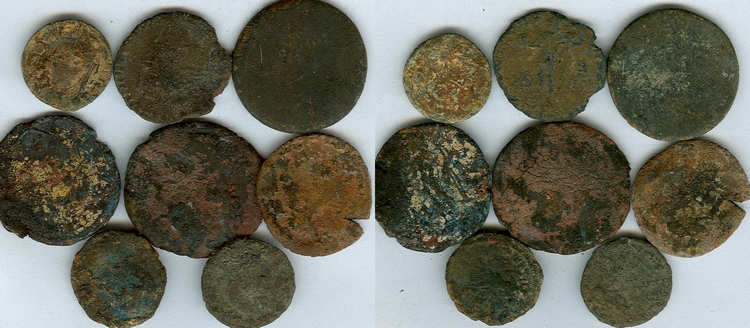
GROUP TWO: 33.3 grams
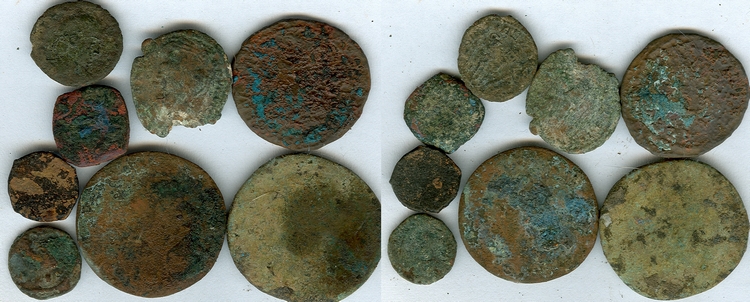
Second phase was for 10 minutes, water sloshed around a couple times as well. Using the same solution.
GROUP ONE: 35.4 grams
GROUP 2: 33.2 grams
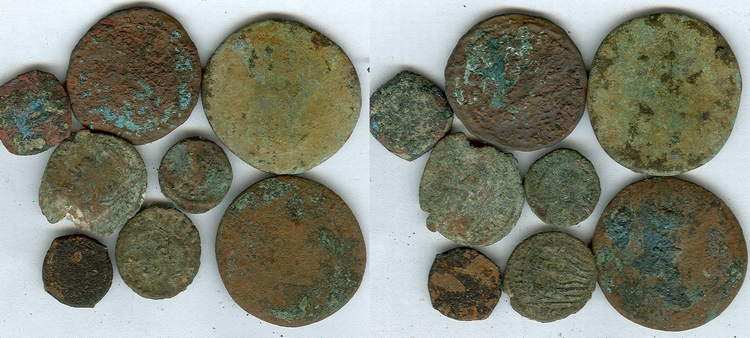
The couple coins that started with an intact patina, seems to be retaining it. Dirt and encrustation is coming off. Next phase is 15 minutes in the same solution.
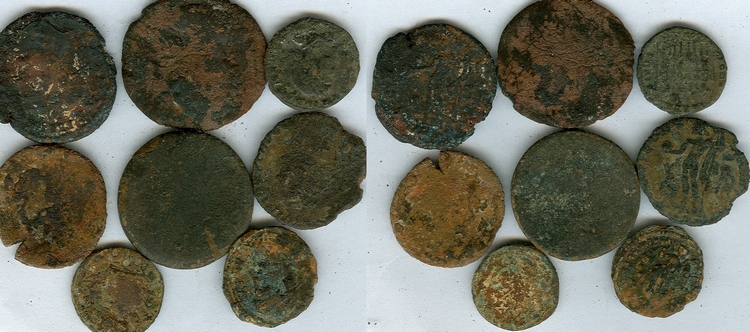
GROUP 1 :35.3 grams
Silvering (though not really showing in scan) is strong and intact. The solid patinas still seem intact, but I fear if I leave them in any longer, it would be removed. Thirty minutes total soaking.
GROUP TWO: 33.1 grams
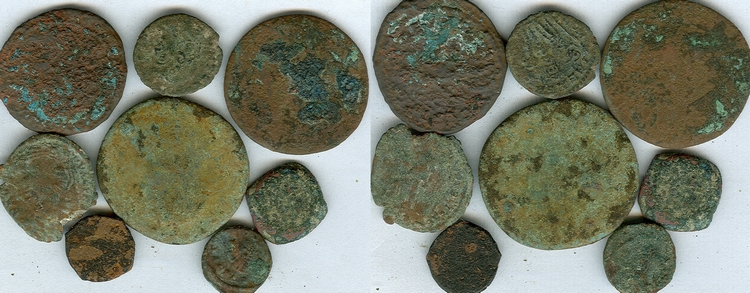
All in all a decent outcome. No ill effects can be noticed and coins are considerably cleaner. I'm going to work on these traditionally now. I believe that lye holds enough promise to warrant more experimentation.
ADDENDUM: I spent perhaps 2-3 minutes with my pin on each coin in Group One, and gave them a quick silver brushing. Coins are down to 34.8 grams. The dirt was amazingly soft... it was similar to working on mud. The Gloria Exercitvs proved to be about 80% silvered, some came off while working with the pin. The scratches on the large orangish coin were caused by the titanium flat end... the orange is some kind of thin oxide over bare metal. No other surprises, and I can't really detect any damage caused by the lye... perhaps 30 minutes soaking is a good time. I know a couple hours will eat patina quite well.
Perhaps I'll have Group One done tomorrow.
I took my 6 micron 3M radial brush to these quick, to get a better idea of what I had.All references concern the positions of the coins in the above scan. The two coins in the middle of the top two rows in the above scan are slugs. I won't be doing anything more with these, though the orange one is countermarked. The middle coin, I knew was a slug, but had it in the experiment for patina purposes. The Jupiter or late Gloria Romanorvm (top right corner), is very rough, and don't have high hopes for it. This is the only coin that I wish I hadn't tested... the reverse is quite worse for the wear with the removal of the orangish dirt. The follis in the left top corner has some pitting, but looks like it will be a nice coin... it has a gorgeous bust. The small radiate middle row, left... is an interesting Barb. Check out the radiate crown on him. The right coin in the middle row isn't very hopeful... it's rough under the orange oxide... but this coin was rough to begin with. The Victory in the left bottom corner should clean up well, though the orange stuff seems a bit difficult at the moment. Finally the Gloria Exercitvs seems to be coming along pretty well.
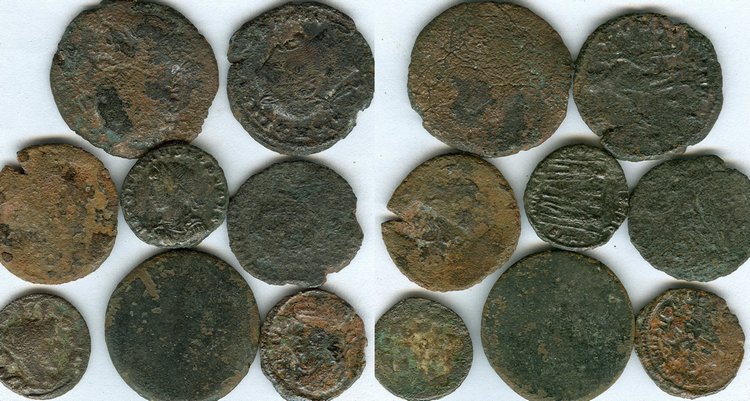
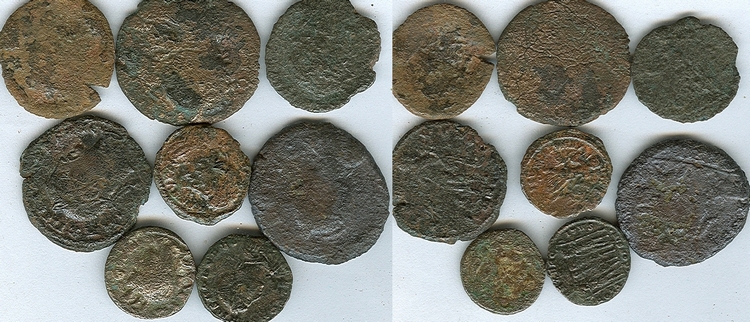
I didn't get to the coins yesterday, but I spent a few minutes on them this morning. Some of the silvering on the gloria exercitvs came off... mainly on the legends and such. I'm not sure if it was the lye or what, but it was definitely loose. I'm not sure what the small radiate is... I thought it was a Barb, but after a little more cleaning, there seems to be a wreath with writing on the reverse... perhaps Judean. The countermark looks counterfeit, and can just barely be seen. The Maximianvs Follis didn't end up too bad, considering what it started as. The Secvritas is still an ugly coin... the black tar refuses to let go, and the orange coloring is here to stay. The Vimancium is ugly, but attributable now
I'll have to try this again, but with "decent" quality coins. These coins were problematic to begin with, and a few actually came out a lot better than I had expected.
Final scan for Group One:
ANOTHER EXPERIMENT 11/29/05
Here are 6 coins that I just received. They were apparently soaked in olive oil for a couple months, and I have boiled them in water with a dishwasher tab, to remove the oil. These should provide a decent cross section of conditions, and are of a higher quality than the previous coins. The one follis, that has encrustation (Jupiter reverse) has some silvering.
I'm going to use a 6:1 water:lye ratio, and let them soak for 30 minutes. Then going to hit them with a toothbrush.
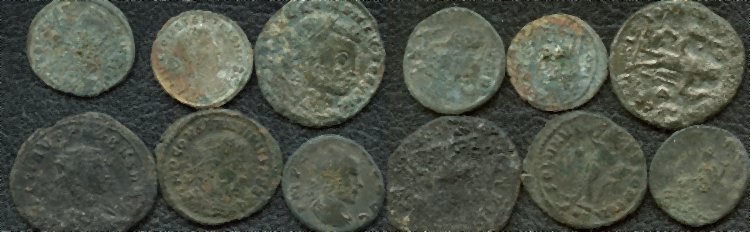
After:
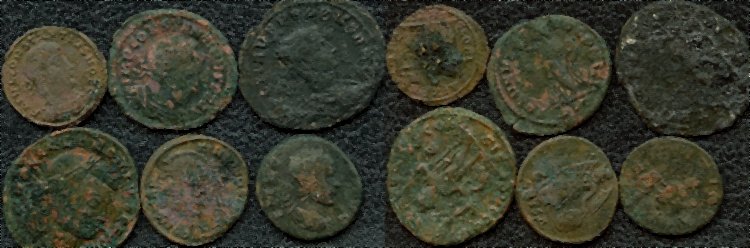
The silvering was removed. Alot of dirt has been removed, along with some encrustation. Some patina seems to have been removed, but I can match lighter spots on the before scan with the removed patina spot on the after... perhaps the patina was already damaged. Perhaps I need to reduce the time, for a straight soak, compared to the earlier experiment with "breaks". Coins are still damp in the after scan, which should explain the darker image. I feel lye still needs more experimentation.
12/02 ANOTHER TRIAL-Fresh coins/25 minutes
Another trial run. These 9 coins are as received. They are standard grade coins, some show some details to begin with, while others show nothing. A nicely encrusted coin there as well. These have not been soaked, brushed or picked at all by me. These will be soaked for 25 minutes in a 6:1 lye solution.
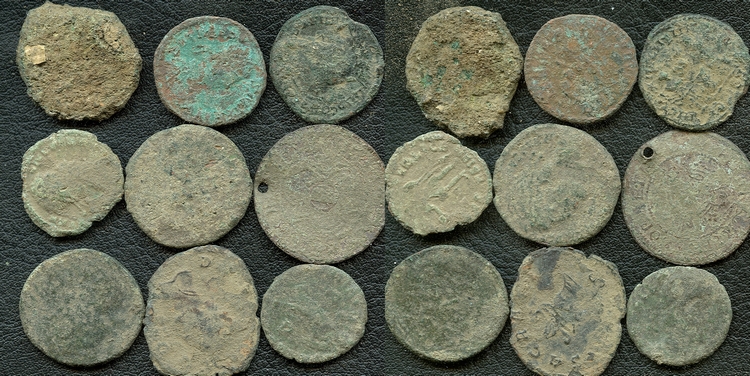
After the soak, and drying, here's what I have.
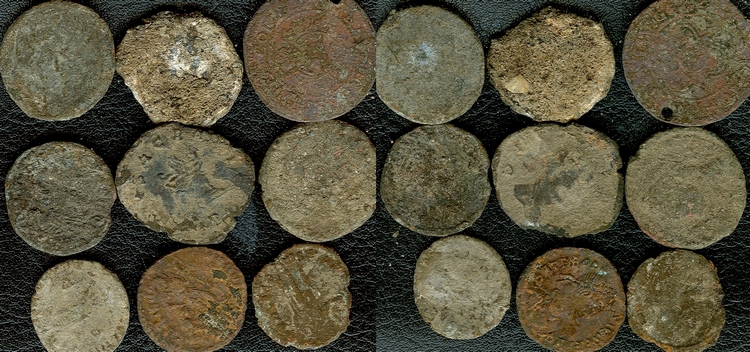
After a toothbrushing, and a silver brushing:
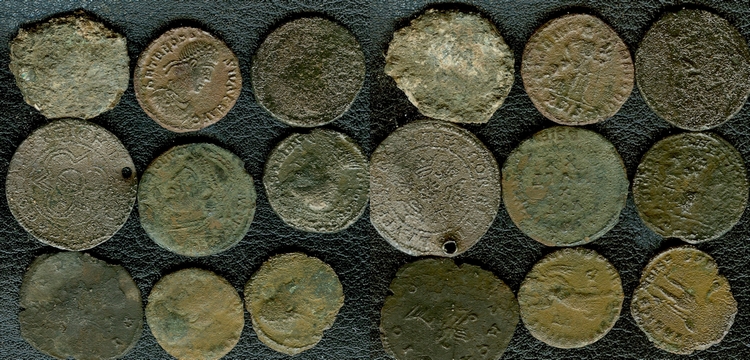
Mixed results really. A couple coins lost patina, mainly ones that looked damaged beforehand though. A good amount of dirt was removed, and most of the encrustation on the encrusted coin was removed. Silvering on the Ant in the bottom left corner in the scan above is intact. I'll probably do yet another experiment, probably 20 minutes. Honestly, I don't mind the brown that is left on the coins that the patina is removed. It's not bare metal, and I like it... I'm liking Lye for the most part.